MIKE^STARK
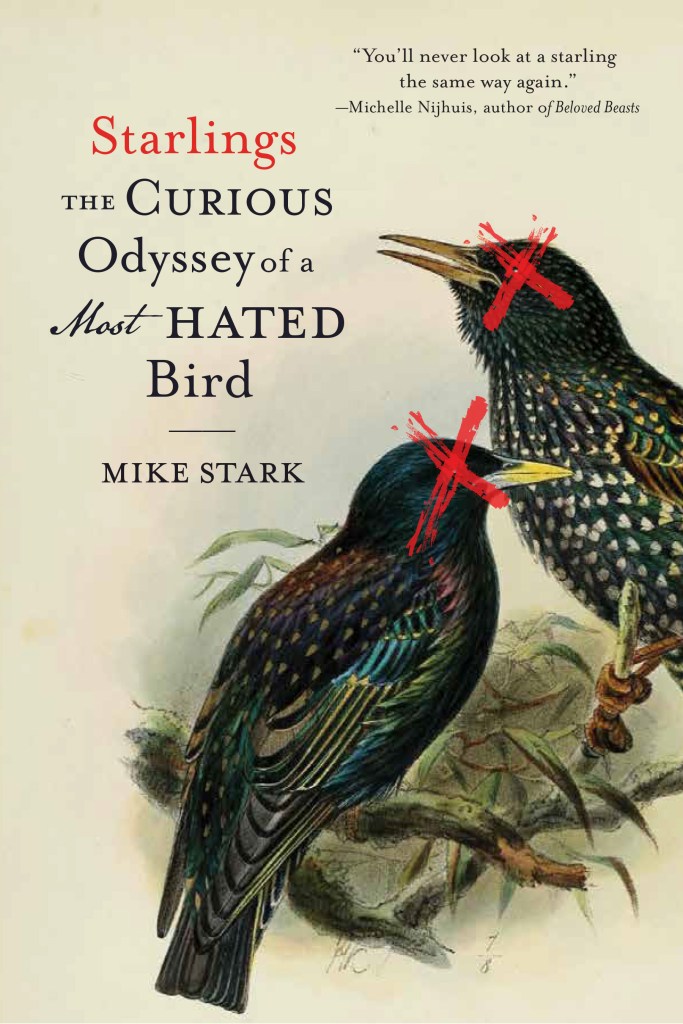
Published in March 2025 by the University of Nebraska Press/Bison Books
About the Book
Has there ever been a more hated bird than the European starling? Let loose in New York City’s Central Park by a misguided aristocrat, the starlings were supposed to help curb insect outbreaks and add to the tuneful choir of other songbirds. Rather than staying put, the dark and speckled starlings marched across the continent like a conquering army. In less than sixty years, they were in every state in the contiguous United States and their numbers topped two hundred million. Cities came under siege; crops buckled beneath their weight. Public sentiment quickly soured.
A bitter, baffling, and sometimes comical war on starlings ensued. Weapons included dynamite, guns, bounties, fake owls, real owls, rubber snakes, balloons, itching powder, and greased building ledges. Still, artists and scientists marveled at their undulating aerial formations, which seemed equal parts poetry and mathematics. Keen listeners recognized the starling as one of the world’s great vocal mimics, imitating everything from fellow birds and cell phones to barking dogs, car alarms, and TV commercials. And then there were their undeniable skills of adaptation and survival. What if there was more to these stubborn villains than once thought?
Mike Stark’s Starlings is a first-of-its-kind history of starlings in America, an oddball, love-hate story at the intersection of human folly, ornithology, and one bird’s tenacious will to endure.
Praise
“A meticulously researched account of the collision of starlings and humans, starting with the species’ deliberate 1877 introduction to New York City by a wealthy “man of leisure” named Eugene Schieffelin. . . . [Mike Stark] writes in lavish detail of the ecological train wreck that swiftly followed as Schieffelin kept importing crates of starlings, as well as house sparrows, skylarks, nightingales and bullfinches.”—Julie Zickefoose, Wall Street Journal
“The perils starlings face and the wonders they inspire earn them their role as epic heroes in Stark’s thought-provoking tale. Balanced and reflective, Starlings calls on readers to challenge their prejudices and misconceptions of one noisy three-ounce blackbird, a vital step in our own journey to recast the meaning of belonging on a chaotic and increasingly violent Earth.”—Julie Dunlap, Washington Independent Review of Books
“Stark recounts tales of ingenious (noisemakers, fireworks) and not so ingenious (tying teddy bears to roost trees) ways that people tried to stop the inexorable march of the starlings from their eastern origin, but he also cites those who enjoyed and respected the bird’s abilities at mimicry as well as their murmurations of hundreds of birds. This combination of human and natural history is a captivating read.”—Nancy Bent, Booklist
“Starlings is both highly readable and deeply entertaining, tracing how starlings went from a solution to a problem. Stark’s book dips and weaves like a starling murmuration from theme to theme, following how Americans have thought about and dealt with their feathered immigrant neighbors.”—Catherine McNeur, H-Environment
“Starlings is a smart, entertaining parable about human foolishness, avian ingenuity, and the unintended consequences of ecological meddling. With wit and verve, Mike Stark tells the epic story of the plucky starling—a bird that enchanted Mozart, exasperated farmers, and ultimately conquered America.”—Ben Goldfarb, author of Crossings and Eager
“Americans have been bewitched, befuddled, and enraged by European starlings for more than a century, and the country’s least-loved nonnative bird couldn’t ask for a better chronicler than Mike Stark. Balanced, whimsical, and deeply researched, Starlings tells the story of how they became the bird we love to hate, and in doing so illuminates our own contradictory human nature.”—Melissa L. Sevigny, author of Brave the Wild River
“In Starlings Mike Stark peels back 150 years of myth and misunderstanding to reveal a fascinating story about human folly, animal smarts, and the value of life on Earth. You’ll never look at a starling the same way again.”—Michelle Nijhuis, author of Beloved Beasts: Fighting for Life in an Age of Extinction
“Starlings is at once one of the most entertaining, readable, and profound bird books I have ever read. … Their delightful story is ultimately part of a larger one about the growing loss and extinction of species around the planet. Stark hopes that, like Rachel Carson and Emily Dickinson, we will finally decide not to destroy those things we have come to love – even the hated starling.”—Bob Musil, president of the Rachel Carson Council
Listen to an interview about Starlings on Arizona Public Media.
Read a wide-ranging interview about Starlings, birds, extinction, art and writing at Orange Blossom Ordinary.
Order here.

Published in October 2023 by the University of Nebraska Press/Bison Books.
About the Book
The Derelict Light takes place in Prohibition-era Astoria, Oregon, a bleak and rain-soaked fishing town where violence and vice have found a home at the edge of the continent. After the Great War the city is awash in strife: civic leaders stoking economic ambitions, Finnish socialists gunning for a revolution, gamblers and boozers operating outside the law, and salmon fishermen just trying to survive the most dangerous river on the West Coast. Then comes the Ku Klux Klan in search of fresh recruits.
When a fire destroys most of the city, and a body is found hanging from the docks, the city tears at its seams. Lines are drawn, and influence wields violence. Inspired by historical events, The Derelict Light explores a Pacific Northwest town in the grips of catastrophe, caught in a bitter struggle between progress, greed, and human frailty.
Praise
“A captivating and gripping novel. . . Stark skillfully reveals the everyday working life of the people in this desolate land where even the river turns treacherous on a whim. He writes with precise clarity and a storyteller’s brilliance. The Derelict Light is one of the best novels I’ve read in a long time.”—Milana Marsenich, Roundup Magazine
“Mike Stark takes us a century into the past in this gripping tale set around the 1922 Astoria fire. The Derelict Light depicts a community in conflict with the era’s prominent leftists—Wobblies and Finnish socialists—organizing to build a better future, and the notorious Klan scheming to further oppress those on society’s margins. The brutal realities of Northwest working-class life jump off the pages of The Derelict Light. Few books, fiction or nonfiction, so ably capture the everyday experiences of working people who lived in this gray, rainy land. Stark deserves praise for penning this captivating novel. A must-read book for anyone with an interest in Northwest history.”—Aaron Goings, author of The Port of Missing Men: Billy Gohl, Labor, and Brutal Times in the Pacific Northwest
“The Derelict Light belongs to the tradition of John Steinbeck’s In Dubious Battle and The Grapes of Wrath, and the American proletarian novels of the 1930s, in highlighting the intersections among work, migration, and politics. Mike Stark does a fine job of creating the world of 1920s Astoria, firmly planting the reader’s feet in the muddy streets. He adds unique and needed detail to our nation’s ongoing conversation about its core principles. An impressive novel.”—Tracy Daugherty, author of 148 Charles Street and Snow and Straw
Listen to an interview about The Derelict Light on Astoria’s KMUN.
Order here.
Winner of the 2023 New Mexico-Arizona Book Award
Reading the West Longlist for Nonfiction
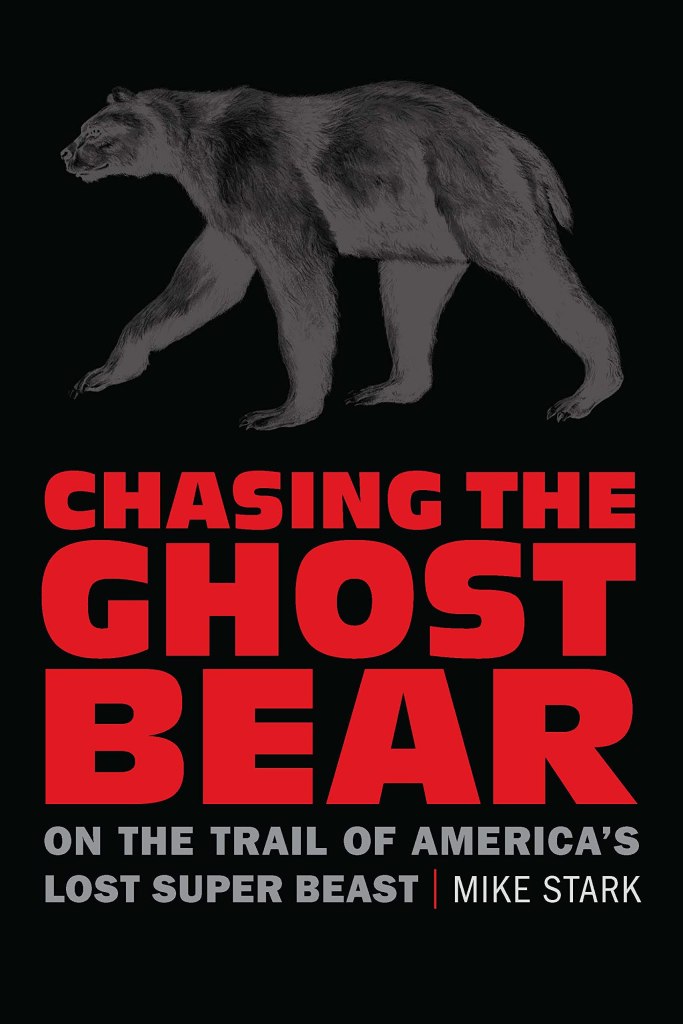
Published in April 2022 by the University of Nebraska Press/Bison Books
About the Book
No animal shakes the human consciousness quite like a bear, and few compare to the giant short-faced bears that stalked North America during the Pleistocene. Even among the mammoths and saber-toothed cats, they were a staggering sight: on all fours, the biggest would stare a six-foot person in the face and weigh close to a ton. On hind legs they towered more than ten feet, with jaws powerful enough to crush skulls and snap bones like twigs.
The bears weren’t invincible, however. Despite their size, they were swept off the planet in a mysterious wave of Ice Age extinctions more than ten thousand years ago, then mostly forgotten. Chasing the Ghost Bear is Mike Stark’s nonfiction journey into the bear’s enigmatic story—its life, disappearance, and rediscovery—and those trying to piece it together today. An engaging guide through his intrepid search, Stark’s story leads us from the La Brea Tar Pits in Los Angeles to a cornfield in Indiana, the far ends of the Arctic, the plains of Texas, and the swamps of Florida.
Part natural history, part travelogue, and part meditation on extinction and loss, Chasing the Ghost Bear returns these magnificent beasts to their rightful place in our understanding of the world just an epoch past.
Praise
“Thank heavens for Mike Stark for rummaging around in creepy caves, unearthing remote museum curators, and otherwise doing the far-flung homework needed to bring us this compelling elegy to one of prehistoric North America’s most spectacular carnivores.” — Paul Schullery, author of Lewis and Clark among the Grizzlies and The Bear Doesn’t Know
“A finely crafted mosaic of natural history, historical drama, and personal odyssey—seasoned with musings about the impermanence of life. . . . Mike Stark has managed to bring back to life not only this fascinating animal—Arctodus simus, the giant short-faced bear—but also the paleontologists who risked life and limb pursuing its scattered remains.” — David Mattson, former longtime grizzly bear scientist for the National Park Service and U.S. Geological Survey
“This book is journalism at its best.”—Vernon Schmid, RoundUp Magazine
“Readers with an interest in paleontology, zoology, or ecology will find this book fascinating. Those unfamiliar with these disciplines may find their curiosity piqued by opening the book.”—J. Kemper Campbell, Lincoln Journal Star
Listen to an interview about Chasing the Ghost Bear on Arizona Public Media.
Order at University of Nebraska Press/Bison Books.

Published in April 2016 by Riverbend Publishing, Helena, Montana.
About the Book
On an island in the middle of Yellowstone Lake in Yellowstone National Park, there’s a wrecked ship—the last dashed hopes of a man determined to find his way in the early profiteering days of the nation’s first national park.
Ambitious, blustery, and paranoid, E. C. Waters arrived in Yellowstone in 1887 and stayed for more than 20 years. He became the most hated businessman in Yellowstone, frustrating park superintendents, irritating customers, and restlessly trying to build a small empire that could outlast his enemies.
Waters pinned his ultimate hopes on a grand steamboat that was assembled piece by piece on the shores of Yellowstone Lake. The boat, like Waters himself, was soon destined to founder.
Thoroughly researched and superbly written by journalist Mike Stark, Wrecked in Yellowstone is the first portrait of one of Yellowstone’s most infamous characters and his place in the tumultuous early years of the park. It is the story of folly, obsession, ruthless competition, and a man overcome by the storms of his own creation.
Praise
“Stark paints the picture of a man who believed he was due everything he worked for money, prestige, protection, and respect and whatever else you had left over, who was born into a hard life and sought whatever escape possible…. The beauty of Wrecked In Yellowstone is how Stark treats his central subject. Whatever his personal opinion, Stark lets others malign Waters with their own words. And he lets others praise him. In spite of his posthumous reputation, Waters was, for a time, well liked…. Of course, there’s more to the story, and if you want to know it, Stark is a very helpful guide, telling the story early Park managers hoped people would forget.” —Yellowstone Insider
“It’s primarily the story of a man with a vision, E.C. Waters. One of the first entrepreneurs in Yellowstone, he was intent on making his fortune on the waves, from the waves of visitors…. This is an interesting book, well researched, and shows how wild and crazy the first tourist concessions were in our first national park.” —National Parks Traveler
“Stark has stepped into the company of some well-known Yellowstone historians like Aubrey Haines, Lee Whittlesey and Paul Schullery, yet no one had tackled the unusual tale of Waters and his ambitions.” —The Billings Gazette
>> MIKE STARK >>
Mike Stark grew up in the Pacific Northwest and spent years as a journalist and writer in the West and beyond, including for newspapers in Oregon and Montana and a couple years with the Associated Press in Utah. He lives in Tucson, Arizona.
GET IN TOUCH
mikestark100 (@) gmail (dot) com

 mikestarkwrites.com